150 mm / 6 Inch Black Polypropylene Wheel
150 mm / 6 Inch Black Polypropylene Wheel for B2B equipment or trailer support projects. Specify the fit-controlling…
Afficher la configuration →
Polypropylene wheels are hard thermoplastic wheels used where a simple, cleanable material family is relevant. Exact grade and environment still require confirmation.
The practical value of Polypropylene Wheels appears only when the specification is tied to the equipment that must move, the floor it runs on and the interface that carries the load.
Within general industrial and wet-area selection, the actual load and fit-controlling dimensions should be treated as the first engineering checkpoint. Once that is known, wheel diameter, width, material, bearing arrangement and mounting details can be reviewed in a rational order.
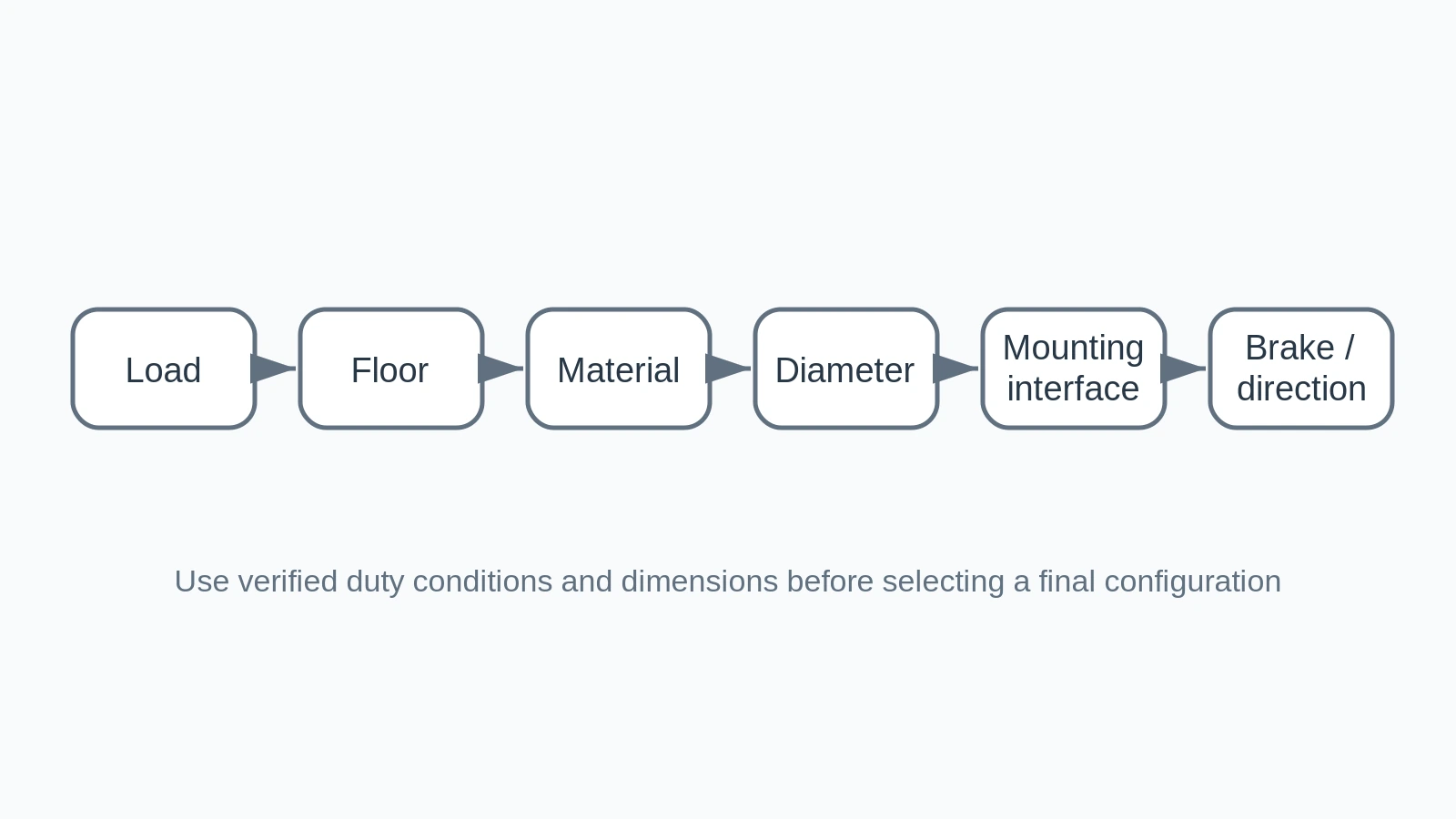
Avoid assuming that a larger wheel, harder polymer or heavier bracket automatically solves the problem. A material or wheel-size label cannot confirm compatibility by itself. The safest RFQ therefore records load, floor, wheel diameter/width, mounting interface, braking need and quantity before a configuration is released for quotation. On Polypropylene Wheels, use this point to narrow the family-level choice before treating any individual configuration as a fit for the equipment.

The live product grid below contains the current configurations represented in this site. Use the grid as a starting point, then compare exact mounting and duty conditions instead of selecting from appearance alone. On Polypropylene Wheels, use this point to narrow the family-level choice before treating any individual configuration as a fit for the equipment.

150 mm / 6 Inch Black Polypropylene Wheel for B2B equipment or trailer support projects. Specify the fit-controlling…
Afficher la configuration →
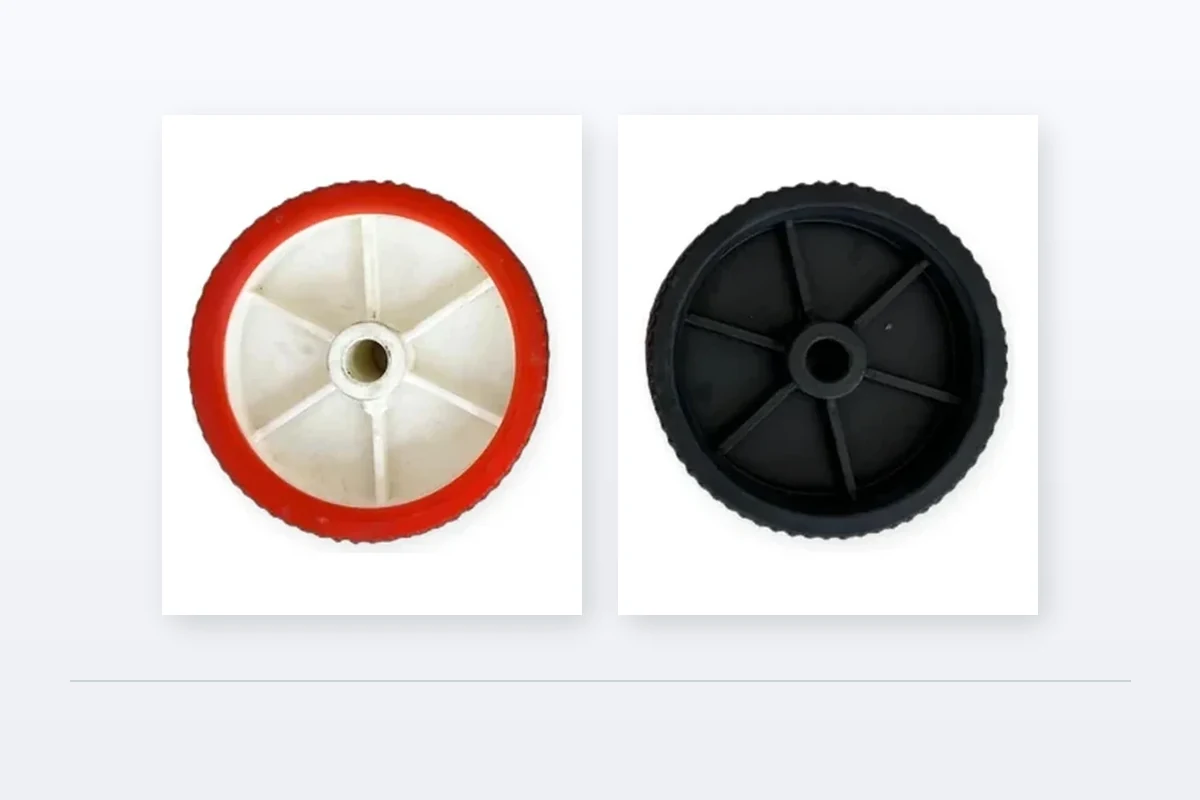
150 mm / 6 Inch Red & White PP Wheel for B2B equipment or trailer support projects. Specify…
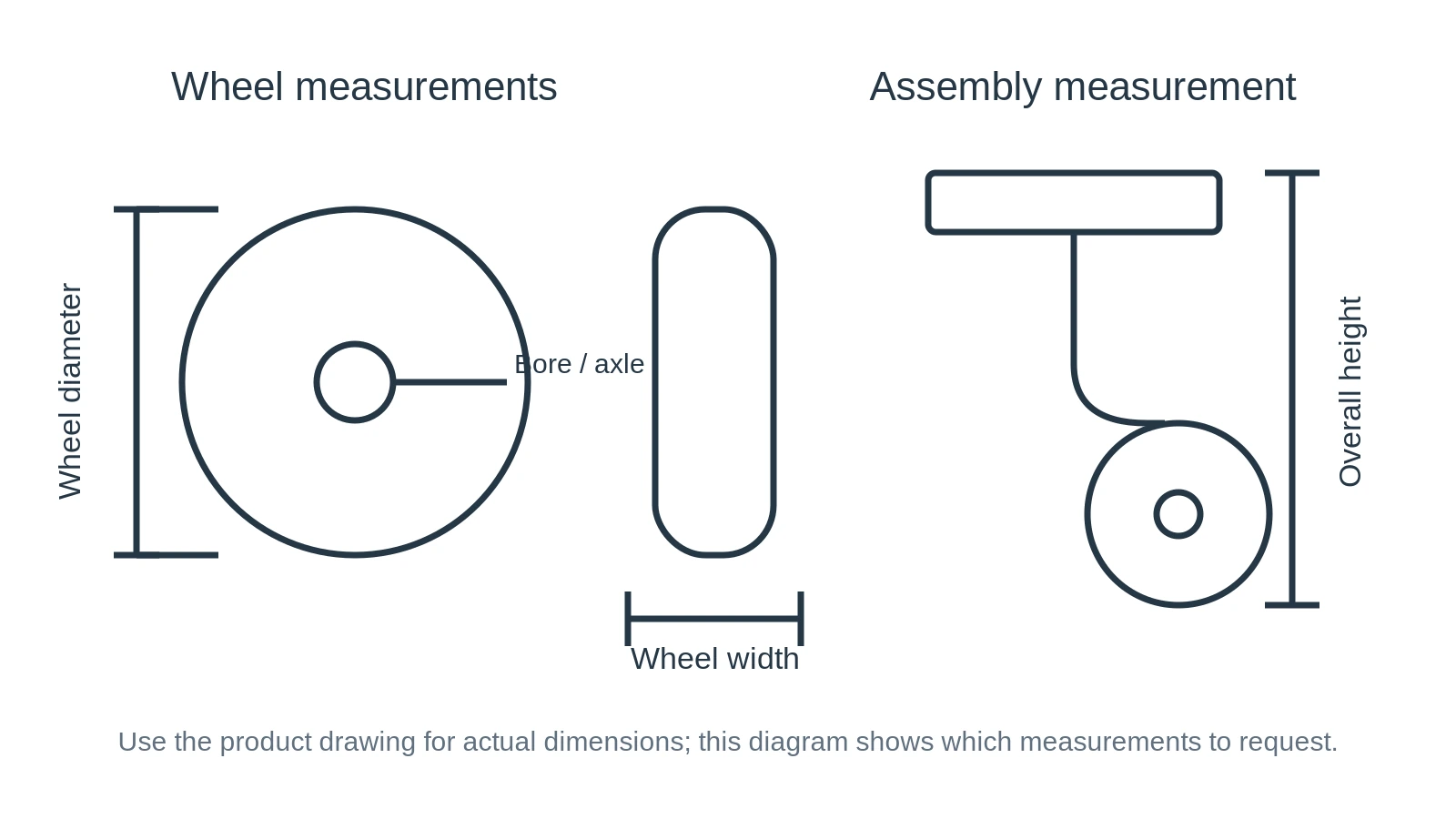
Afficher la configuration →Shortlisting this family is most reliable when every candidate is compared against the same application description. Record wheel diameter, width, material, bore or bearing arrangement, hub length and real load per supporting point before comparing catalogue names or photographs. This keeps the decision tied to the equipment rather than to one attractive feature. On Polypropylene Wheels, use this point to narrow the family-level choice before treating any individual configuration as a fit for the equipment.
For replacement work, add floor condition, joints or thresholds, axle retention and the amount of side clearance available inside the bracket or frame. Where an existing part is worn, bent or repaired, identify the dimensions that may no longer represent the intended geometry. A measured drawing or dimensioned photograph is more useful than treating visible wear as the design target. On Polypropylene Wheels, use this point to narrow the family-level choice before treating any individual configuration as a fit for the equipment.
When several configurations are being compared, keep required values and optional preferences in separate columns. If a fit-controlling number is not available, leave it as a confirmation item in the RFQ instead of borrowing a value from another size or series. On Polypropylene Wheels, use this point to narrow the family-level choice before treating any individual configuration as a fit for the equipment.
Use the Polypropylene Wheels page to narrow material and geometry before comparing individual configurations. For wheel-only items, the final selection still depends on the equipment-side axle or bearing interface, hub space and the floor route. Compare candidates at the same carried load and with the same assumptions about joints, ramps, debris and manoeuvring. If a material property, bearing arrangement or load rating is not shown for a particular configuration, keep it as an RFQ confirmation point rather than treating the family description as a specification for every wheel in the range.

| Variable | Pourquoi c'est important |
|---|---|
| Charge par point d'appui | Les cadres ne répartissent pas toujours la masse totale de manière égale, surtout sur les sols irréguliers. |
| Diamètre de la roue | Modifie la garde au sol et la géométrie de franchissement d'obstacles. |
| Largeur de roue | Cela modifie la surface de contact et peut avoir une importance sur les terrains meubles. |
| Matériel | Influe sur la dureté, l'interaction avec le sol et l'adéquation à l'environnement. |
| Alésage / roulement / essieu | Permet une installation sur roue uniquement, sans charge latérale ni entretoises improvisées. |
| Support / tube / plaque | Contrôle l'ajustement de l'assemblage complet et le dégagement à proximité. |
| Fonction frein/verrouillage | Doit correspondre aux exigences réelles en matière de stationnement ou de signalisation. |

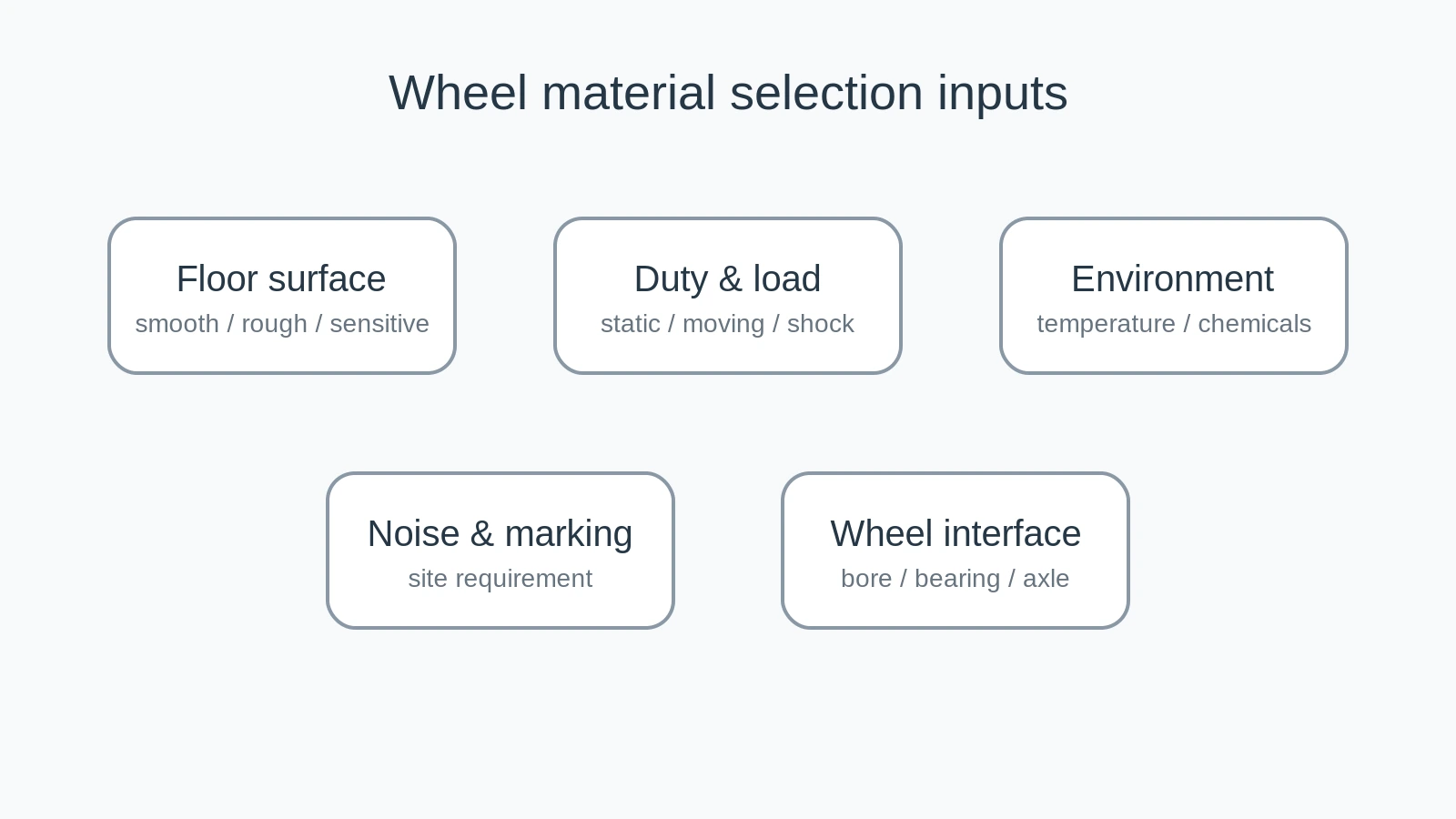
Polypropylene Wheels can appear in general industrial and wet-area selection, but the correct configuration is always application-specific. Material handling equipment may spend most of its time on smooth concrete, while trailer support wheels may roll over paving, compacted ground or gravel for short manoeuvring distances. Those are different design conditions.
Describe ramps, floor joints, wash-down, debris, outdoor exposure and expected travel in the enquiry. If the equipment is already in service, a short video can reveal interference or steering behaviour that a static photograph does not show. On Polypropylene Wheels, use this point to narrow the family-level choice before treating any individual configuration as a fit for the equipment.

Do not select a polymer only by colour. Confirm the required material family and, where chemical exposure or unusual temperatures matter, state the environment so the exact grade can be reviewed. For wheel-only replacements, the axle and hub interface is as important as diameter; for complete assemblies, plate, tube or clamp dimensions control whether the product can be mounted safely. On Polypropylene Wheels, use this point to narrow the family-level choice before treating any individual configuration as a fit for the equipment.
Where a custom configuration is required, send the existing drawing or a dimensioned sketch. A dimensioned enquiry is faster to evaluate than a request for a visually similar product. On Polypropylene Wheels, use this point to narrow the family-level choice before treating any individual configuration as a fit for the equipment.

Pour une méthode plus large, utilisez notre guide de sélection des roues et guide des mesuresPour les travaux axés sur les bandes-annonces, le page de demande de remorque ajoute des contrôles de dégagement au sol et de dégagement rangé.
Non. La charge, la largeur, le matériau, l'interface roulement/essieu ou support et les conditions de service doivent encore être examinés.
Envoyez une photo et décrivez le type de sol, la charge et l'environnement. Ne devinez pas le matériau à partir de sa couleur.
Les modèles mixtes peuvent être évalués commercialement. Conservez chaque configuration sur une ligne distincte, en indiquant la quantité et les dimensions.
Ce site est destiné aux demandes de renseignements concernant des projets et de la production B2B, et non aux achats au détail de 1 ou 2 unités. Des échantillons d'évaluation payants peuvent être envisagés pour les nouveaux projets.
Veuillez nous communiquer la demande, la quantité et les dimensions que vous connaissez déjà. Les détails essentiels manquants pourront être examinés avant l'établissement du devis.