Korea Ever-Power Plastic Castor Co., Ltd. · Sandan-ro | Danwon-gu | Ansan-si | Gyeonggi-do | Korea[email protected]
Request a Quote

Product Family

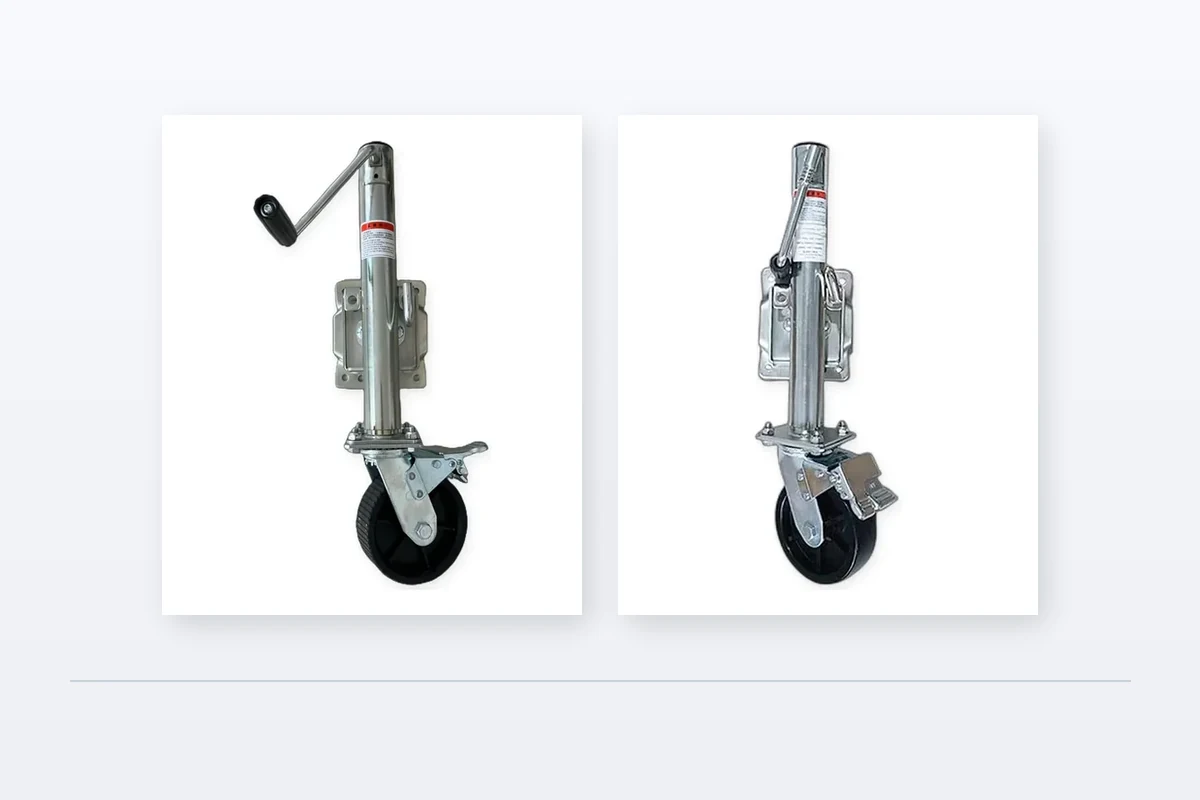
Braked Jockey Wheel Assemblies

Brakeable jockey-wheel assemblies add wheel-level parking control. Brake presence does not replace correct load, mounting or ground selection.

What buyers should define first

The practical value of Braked Jockey Wheel Assemblies appears only when the specification is tied to the equipment that must move, the floor it runs on and the interface that carries the load.

Within controlled trailer support, the actual load and fit-controlling dimensions should be treated as the first engineering checkpoint. Once that is known, wheel diameter, width, material, bearing arrangement and mounting details can be reviewed in a rational order.

Avoid assuming that a larger wheel, harder polymer or heavier bracket automatically solves the problem. A material or wheel-size label cannot confirm compatibility by itself. The safest RFQ therefore records load, floor, wheel diameter/width, mounting interface, braking need and quantity before a configuration is released for quotation.

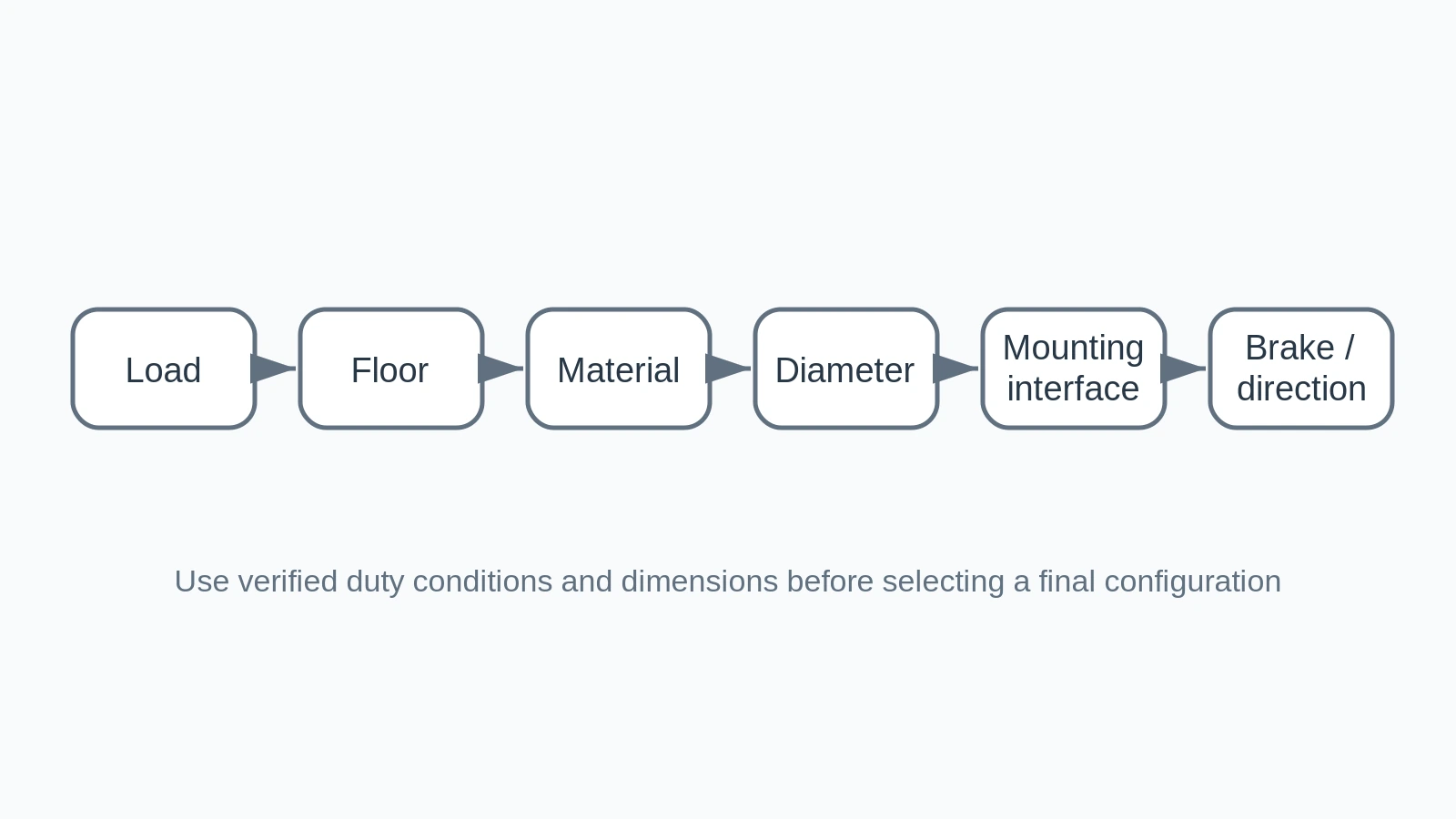
Castor and wheel selection flow
Current Range

Available configurations

The live product grid below contains the current configurations represented in this site. Use the grid as a starting point, then compare exact mounting and duty conditions instead of selecting from appearance alone.

Selection variables

Variable Why it matters
Load per supporting point Frames do not always distribute total mass equally, especially on uneven floors.
Wheel diameter Changes ground clearance and obstacle-crossing geometry.
Wheel width Changes contact area and can matter on softer ground.
Material Affects hardness, floor interaction and environmental suitability.
Bore / bearing / axle Controls wheel-only installation without side load or improvised spacers.
Bracket / tube / plate Controls complete-assembly fit and nearby clearance.
Brake / lock function Must match the actual parking or directional-control requirement.
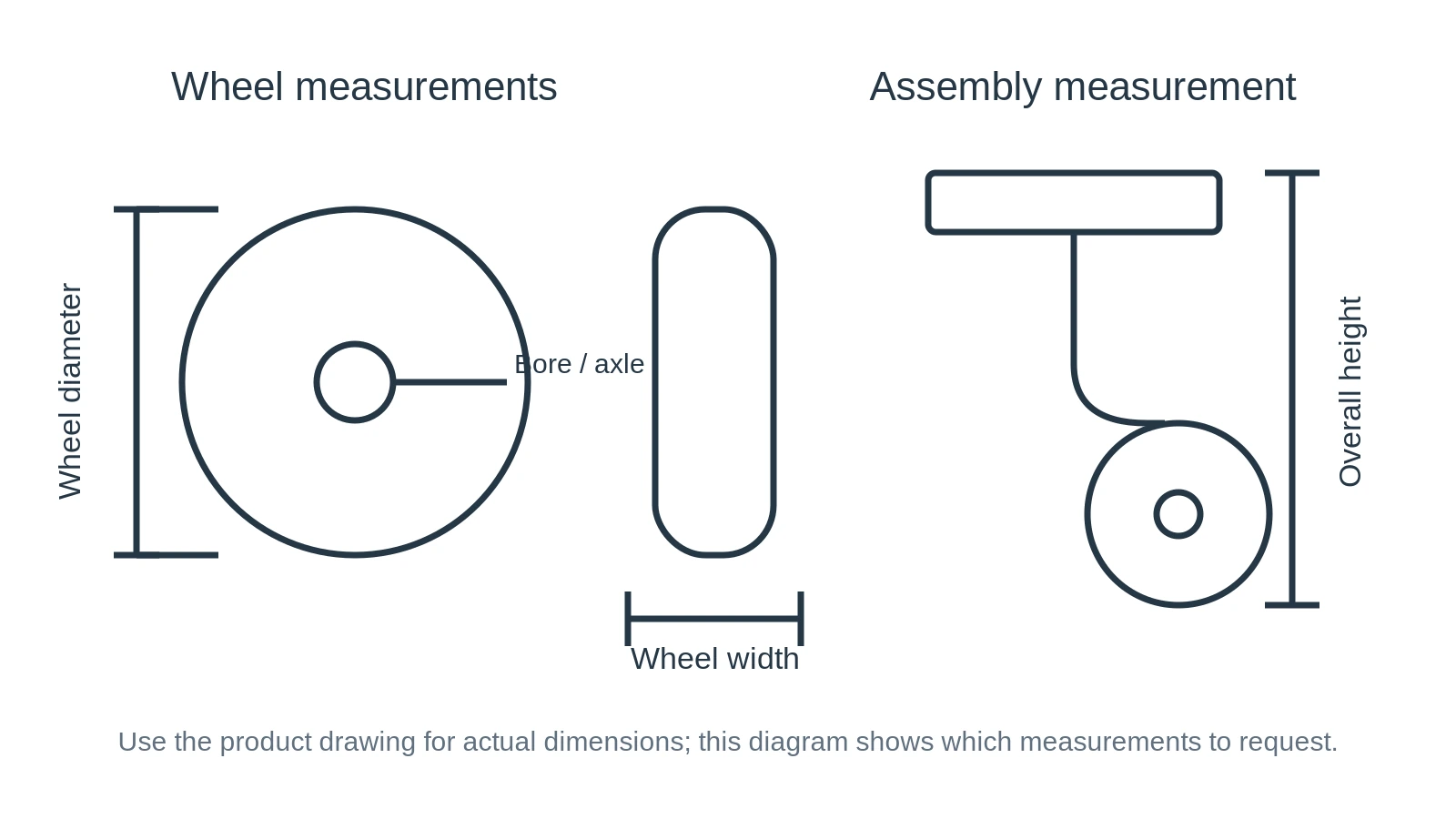
Wheel and castor measurements

Where this product family is used

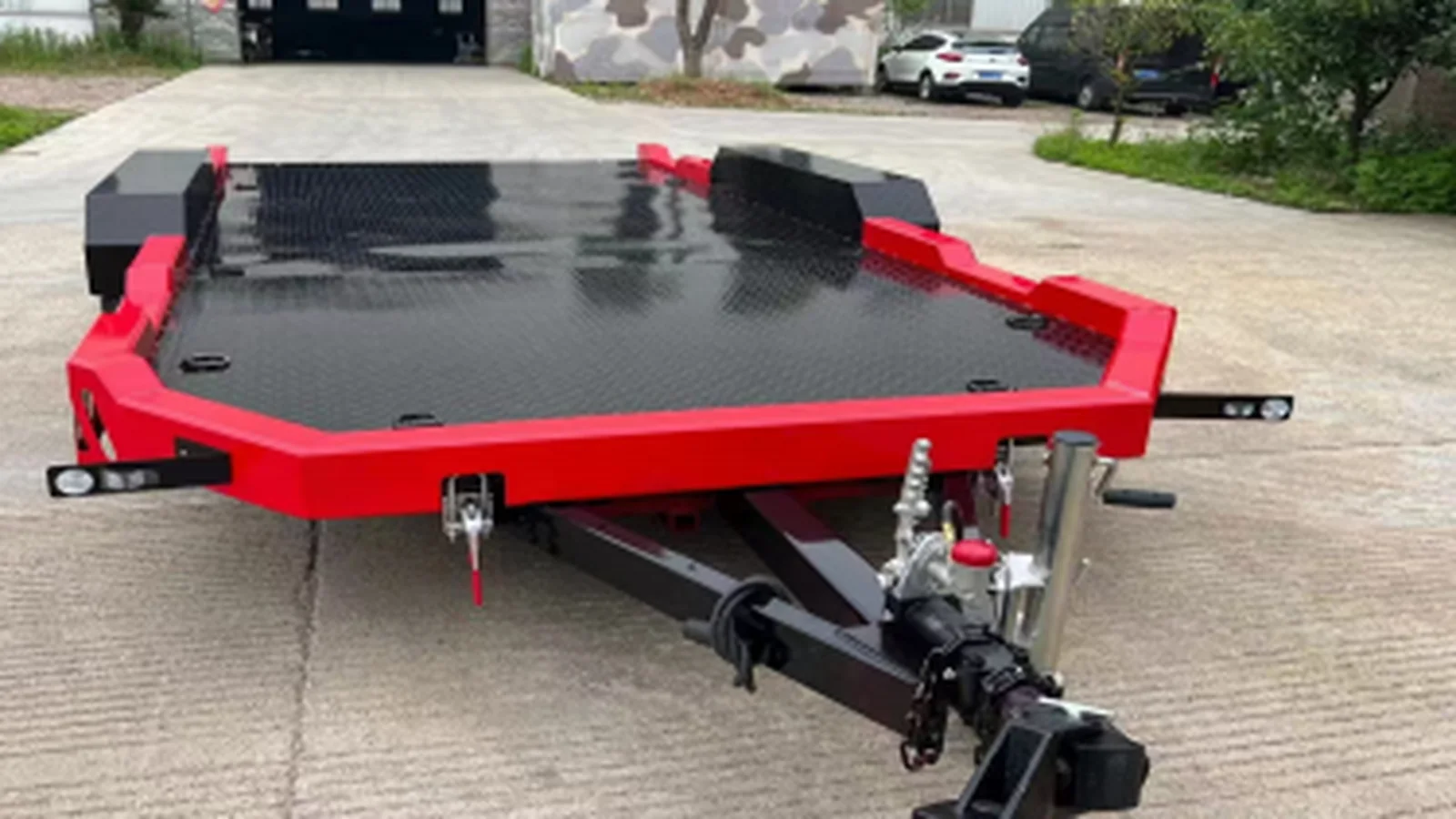
Braked Jockey Wheel Assemblies can appear in controlled trailer support, but the correct configuration is always application-specific. Material handling equipment may spend most of its time on smooth concrete, while trailer support wheels may roll over paving, compacted ground or gravel for short manoeuvring distances. Those are different design conditions.

Describe ramps, floor joints, wash-down, debris, outdoor exposure and expected travel in the enquiry. If the equipment is already in service, a short video can reveal interference or steering behaviour that a static photograph does not show.

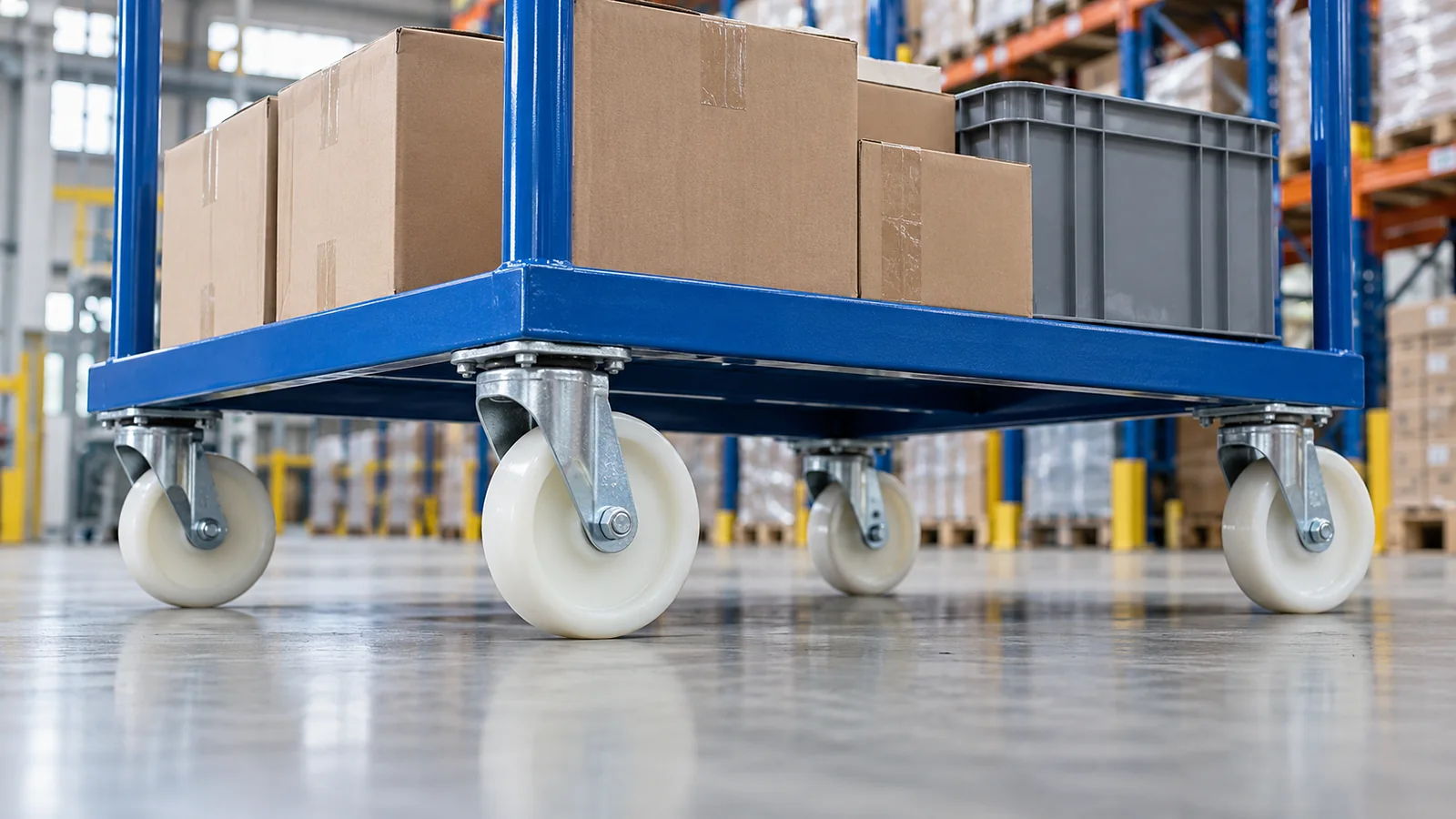
Braked Jockey Wheel Assemblies application context

Material and interface checks

Do not select a polymer only by colour. Confirm the required material family and, where chemical exposure or unusual temperatures matter, state the environment so the exact grade can be reviewed. For wheel-only replacements, the axle and hub interface is as important as diameter; for complete assemblies, plate, tube or clamp dimensions control whether the product can be mounted safely.

Where a custom configuration is required, send the existing drawing or a dimensioned sketch. A dimensioned enquiry is faster to evaluate than a request for a visually similar product.

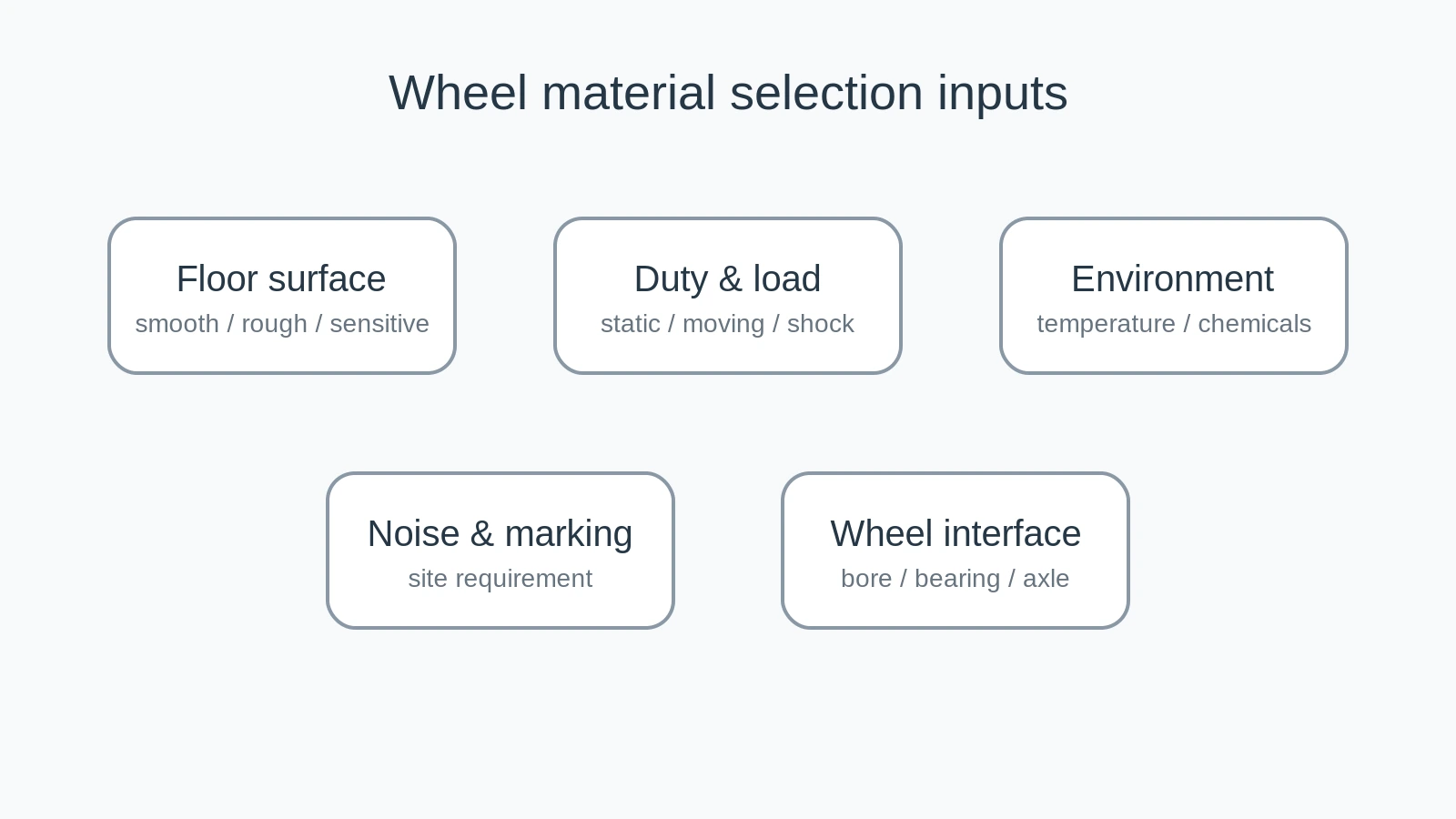
Wheel material selection framework

RFQ checklist

  • Maximum equipment weight and carried load
  • Number of supporting wheels or assemblies
  • Wheel diameter and width
  • Bore, bearing, hub length or axle details
  • Tube, plate, clamp or bolt-hole dimensions when applicable
  • Floor or ground surface, obstacles and cleaning environment
  • Brake or directional-control requirement
  • Quantity and drawing/photo

For a broader method, use our wheel selection guide and measurement guide. For trailer-focused work, the trailer application page adds ground and stowed-clearance checks.

Frequently asked questions

Can I select only by wheel diameter?

No. Load, width, material, bearing/axle or bracket interface and duty condition still need review.

What if I do not know the material?

Send a photo and explain the floor, load and environment. Material should not be guessed from colour.

Can different models be combined in one order?

Mixed models can be reviewed commercially. Keep each configuration on a separate line with quantity and dimensions.

Do you accept one-piece retail orders?

The site is intended for B2B project and production enquiries rather than 1-2 piece retail purchases. Paid evaluation samples may be considered for new projects.

Procurement note

When several sizes are being evaluated, build a comparison sheet with one row per configuration. Keep dimensions, material, finish, quantity and application notes in separate columns. This reduces the chance that a dimension from one model is copied to another and makes quotation revisions easier to control.

For replacement programs, retain the old wheel or assembly until the sample has been checked on the real equipment.

Fit First

Build the shortlist around the dimensions that control fit

For braked jockey wheel assemblies, the fastest way to narrow the range is to record wheel material, brake function, bracket geometry, support load, parking surface and clearance. These fields describe the physical and operating boundary of the part rather than only its appearance. They also help separate a wheel-only replacement from a complete support or castor assembly.

If the existing part is worn, measure from stable metal datums where possible and note which dimensions may have changed through service. A worn outside diameter or elongated hole should not automatically become the target size for the replacement. Keep the old component or a dimensioned drawing available until the first sample or approved configuration has been checked on the equipment.

Build the shortlist around the dimensions that control fit
Comparison

Compare configurations on the same operating assumptions

A fair product comparison uses one duty description for every candidate: the same equipment weight, payload, supporting points, floor or ground, travel pattern and environmental conditions. Changing those assumptions between options makes nominal ratings and wheel sizes difficult to compare. Where shock, thresholds or uneven load sharing are relevant, include them explicitly rather than treating the application as a static laboratory condition.

For procurement, keep material, finish and interface requirements in separate fields from the load or size description. This makes it clear which characteristics are mandatory and which can be proposed as alternatives. It also prevents a finish or material from being copied to a similar model simply because the photographs look alike.

Compare configurations on the same operating assumptions
Commissioning

Plan the first installation as part of the purchase decision

Before a production order for braked jockey wheel assemblies is released, plan how the first unit will be checked. Confirm physical fit, wheel rotation, clearance through the expected motion, fastener seating and behaviour on the real floor or ground. For braked, folding or lifting assemblies, operate the mechanism through its usable range before placing it into routine service.

Record the accepted dimensions and configuration with the purchasing reference. That gives repeat orders a stable baseline while still allowing the application to be rechecked if the load, floor, equipment frame or operating environment changes.

Plan the first installation as part of the purchase decision

Discuss your braked jockey wheel assemblies requirement

Send the application, quantity and the dimensions you already know. Missing fit-critical details can be reviewed before quotation.

Request a Quote